Disagree. This is exactly the problem.
The Post That Will Not Die
4 degrees less timing won’t eliminate this problem or make a positive change to the performance. After spending time on this vehicle, checking, road testing and feeling the symptom I have a lot better idea of what is going on. From where you are at, how do you know we didn’t try retarded timing? Please don’t get me wrong, I appreciate everyone’s input, but timing is not exactly the problem. It’s too bad Mario is 8 hours away from me. I’d love to try a distributor with a Pertronix 1 and maybe swap on a different carb.
The engine does during a snap throttle. It’s not fixed yet, so here we are.
I drove the car from the show about 40 miles with the jumper wire to my in laws house Saturday, besides the off idle problem, the car ran on the highway and in traffic. The tach is was bouncing and reading 1/2 or so of the actually rpm, and then stopped working. I have not had a chance since I been back to look at the car.
If you are driving around with a jumper wire from the battery + to the coil + you are likely going to fry the coil and yes the tachometer should not read anything.
Yes that is the only way we could get it to run. I am going to go back to the 1.5 ohm coil and points( ordered a new distributor) and see what it does.
I also need to redo the engine ground wire. I had it from the valve cover to the firewall. Not sure if the way I had the found wire would cause the issues I was having
Good info, seeing and hearing is invaluable. I missed the timing light troubleshooting, good idea trying to rule that out. There isn’t a lot to a Ford ignition, could be tach wiring, bad engine ground, bad body ground, crappy wires, failing resistor wire, bad connection, etc.
The tach crapping out is interesting, is it a Ford factory tach or aftermarket? If aftermarket, unhooking the trigger wire would be a smart thing to try next. I haven’t seen a lot fail, but I have seen a few, and it is intermittent
This is a factory tach
My thought is since the tach is reading off the positive side of the coil, adding the jumper wire is providing a strait 12 volts and flattening out the signal for the tach. Hopefully, when the points distributor is installed the tach will receive proper signal and come back to life.
How easy would it be to unhook the tach and see if it runs well?
I ran a jumper wire from the 12 v wire I ran to the positive of the Pertronix unit( tach out of loo), ran a new engine Ground wire to engine head, ( checked one spark plug gap , they are set at 0.042)
Drove car, still hesitating low rpm in all gears
To me it sounds like a jetting problem on the carb.
How hard would it be to swap with another known good one?
I agree, if any way to try a different carb, it would allow you to rule it out
instead of just changing carbs check the jet size. cut the fuel to the carb and let the carb run out of gas then disconnect the fuel line and remove the float bowl (4 screws) and the jets are in the plate they should be numbered see what size they are and go from there. 2 jet sizes larger may solve the problem. Also check the adjustment on the arm and spring that plunges the accelerator pump it should not have pressure on it till the accelerator is hit
The only problem with just changing the carb is what kind of engine is the carb set up for if its a used carb.
Yeah, I agree with changing jets first.
I just switched coils to a true 12 volt unit after discovering that I’m always getting 12 volts at the coil 24/7.
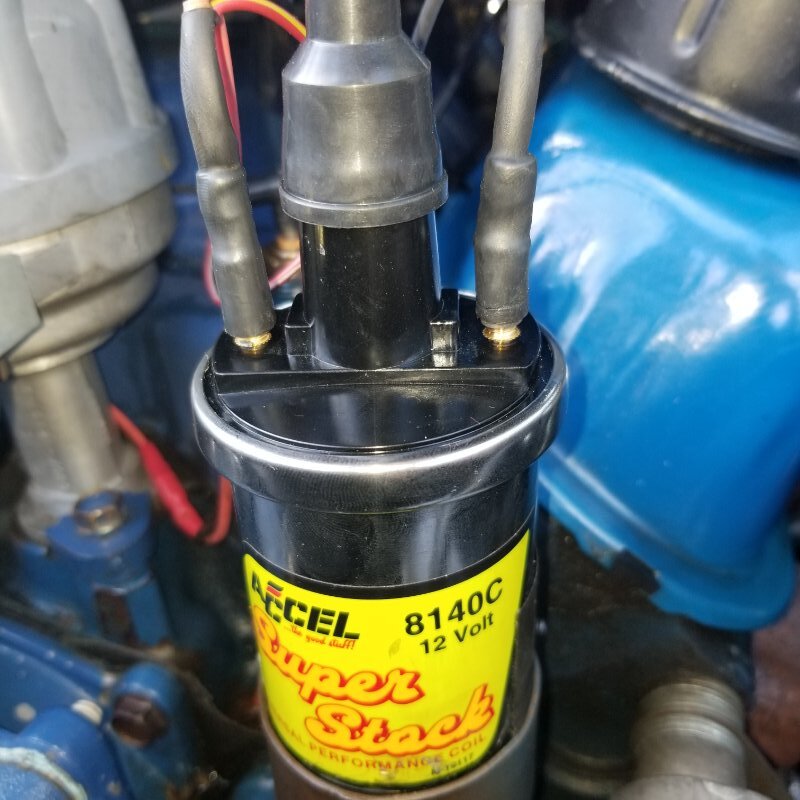
It’s a true inline 12 volt one, no pink resister wire need apply!! I also updated my Petronix.
Disclaimer: It’s on a 302 not a 390.
Petronix also makes entire distributors, not just points eliminators.
https://www.summitracing.com/parts/pnx-d134630/make/ford
Summit also makes improved versions of Holley carbs. The big question I’d like to know is if the problem persists when an entirely different carb is used.
These improved Holley type carbs from summit have transparent float bowls and annular boosters like the new Edelbrock AVS2 carbs have.
I do think it’s a good idea to look inside the carb, mostly for indications of “super tuning” LOL
If he goes this route, post the LIST number and we can tell him what the stock setup will be, true, if it was “improved” could be a lean main circuit. I am still concerned with cross channeling though. Every Holley carb that I do, in the very least, gets filed dragged across to check for straightness (they never are), most get machined, some get filed as a cleanup. When you add the “tightened up the float bowls” it’s very likely that the corners are curled.
In the old days, the miserable shellacked gaskets used to glue themselves to all surfaces, bad for rebuilders and racers, but forgiving for crooked surfaces. The new gaskets don’t stick, but they are less forgiving without proper gasket crush, also, the hard plastic float bowl washers put a lot more pressure on the threads which make the problem worse. Think about the old game in school where you held a parachute down by the outer edge, it stayed high in the middle. Same here, the clamping force is only on the outside and those corners are also unsupported. You would be amazed how crooked they can become and how little compression on the gaskets afterwards
Also, the accelerator adjustment check above may not really say much , pressure adjustment at rest isn’t an adjustment check. The adjustment is .015 from bottoming the arm when at WOT. Easiest way for one person to do it is to use a spring (engine off) to hole the carb at WOT, then use a screwdriver as a lever to hold small pump arm (on float bowl) fully compressed, and adjust it to have .015 clearance.
Last just a public service announcement from an engine and carb guy, typically, carbs need to be jetted to themselves mostly, not to the car. I know that sounds odd and against the hot rod mags, yes there are some tweaks that need to be made here and there, but they are minor. If you think about air and fuel metering, for the most part, the air is fixed when compared with the fuel. If more air flows due to demand, more fuel flows, the carb can adjust. That’s why there are idle and high speed air bleeds as well as sometimes emulsion kill bleeds on the main circuit, to keep it stable as airflow changes.
One or two jet sizes from stock, or more if you tweak the power valve restrictors is possible, but in the end, the area that lets air in is relatively fixed, and therefore, the total area of fuel orifices and bleeds stay relatively fixed unless the carb is severely undersized or oversized.
Many times, the best thing we do, and almost always by most carb guys, is to return a modified carb to stock. That means it’s probable, that a carb that is working well on something else, will likely work well on another engine. So throwing a known good carb, not something off the floor, can usually rule out or incriminate the carb.
Those on the FE forums likely remember last month one of the guys had a high dollar custom carb on a SOHC FE, we finally got him to slap a stock 850 on it, and it ran great. He is now trying to work with the “custom” carb guy to make the special carb work LOL
I can check the jet size, I do have a new stock distributor Install points for now and take out the Pertronix) and 1.5 ohm coil Coming in this week, I was going to install them this week.
I also had a friend that sent me his old holly carb; will not install this carb until I can get it checkout,
I will also check to see if my tach is working with the new distributor, and either way might get a rebuilt one from rocket man
I think it’s:
ignition timing is jacked
too hot of a pertronix setup
jacked carb on it
distributor is jacked too
Junk yard for this car. Buy 1977 Toyota Corolla. 2TC engine is Hemi! Very nice!