I didn’t know that the Holley carbs had such a huge problem with warpage where they meet up with the intake.
Back when I brought mine home, I had a Holley on it that was basically untunable. I never checked that measurement. Then I gave up on it and got an Edelbrock AVS2 500cfm unit on it, which has since given me zero issues.
I haven’t seen them warp at the intake, it’s usually a cast piece and if it’s not flat it would crack
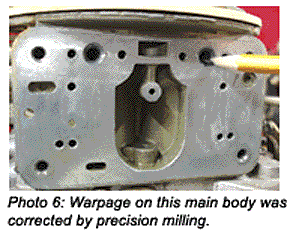
Where they do warp like CRAZY is the two metering plate surfaces where they meet the carb main body. I stole a pic from enginebuilder magazine. In a 4150 front and back are bad, in the 4160s they use a fixed jet plate and they seem to do a lot better because they are held on by their own screws not the float bowls
I am not sure the cause, likely a combination of only being clamped around the outside by the 4 float bowl screws, the lack of compressibility by the booster flares compared to the rest of the carb and gaskets, and heat cycling, but every one is high on the 4 corners. Mild ones you can clean up with a large flat file, but if you are set up a mill does better and quicker work.
When you look at the hole that the pencil is in, that is the main booster, , next to it are air feeds, and way below it are idle and transition fuel holes. When those gaskets do not seal because they are not compressed, the air and fuel can cross channel (leak across the gasket) and it makes a mess without ever seeing it
New Distributor Update: I installed a factory distributor with points, and I had also installed a 1.5 ohm coil. Set the timing to 10 degrees and drove the car this weekend, very minimal hesitation. I had put the car back to the factory wiring, and the tach was also working.
In fact it was running so good, my wife drove the car (it has been awhile since she has driven a stick shift, and her only concern was getting use to the steering). I had put over 50 miles on the car.
That brings us to yesterday, I had thought I had broken my tach, so I had contacted rocketman and have purchased the tach upgrade, I removed the tach on Tuesday and in order to run the car I connected the two wires together that were going to the tach, I went to take it for a ride yesterday, and I am now back to where the car does not want to run, hesitating just like before, I did not have time to run the 12v jumper wire to the coil.
Is there something I am missing when I took out the instrument cluster, I did not touch the engine, or timing etc.
The presence of the tach should not affect the car’s running if the tach is working. Removing the dash cluster should not affect the car’s running either. You can test this by reconnecting the tach and testing the car again. If it doesn’t run right, the tach is not the issue. However, by removing the dash cluster, you may have inadvertently moved some wires related to the ignition and that might do something. I’m now suspicious of a flakey connection at the ignition switch. I’m guessing this is a 1967 or 1968? The 68 ignition switch connector is well known to have issues.
It is a 68, I do have a 12 volt wire from the ignition switch I had ran for the Pertronix unit, I was going to run that to the coil and see what happens
Is there a way to check the ignition switch and what am I looking for
Thank you
Ok so I have still been struggling with the hesitation, I ended up trying a Freind’s Holley 600 carb same hesitation.
I went back to my carb, reinstalled the Pertronix 2 system today, BUT I KEPT THE PERTRONIX stock 1.5 ohm coil (I was thinking closer to stock) ran the car but still have off idle hesitation.
I decided to take the car back to my office garage tonight 8 miles away, and when I went to start the car, all my gauges and turn signals, overhead lights did not work, I decided to just drive it,
TO MY SURPRISE, the car ran the best it had all day, still hesitated a little ( but I think this might now be the carb or timing)
Does anyone know what to look for, what wire or problem I am having, and would this effect the circuit that runs the ignition system
I’d check the ground wire for the fuse box just above the gas/brake pedals. Also confirm the ground strap or cable from the engine block to chassis.
My thought is that the current load was much less since many of the lights were not working. So any weak ground wires (paths) will be less detrimental to the ignition system.
I recall doubling the brightness of my dash lights by adding a dedicated ground wire from the fuse box to firewall. It seems the factory wire connection was long gone by the time I purchased the car.
It’s just a hunch so…but the technical explanation is less voltage drop through the wiring system because less current is flowing. In layman terms, when the lights are off you might get something like 13.5 volts to the ignition. When the lights are on you might get something like 10 volts to the ignition. I just made up the volt numbers for illustration purposes. Point being that one voltage is above 12V and the other is below 12V.
There is nothing about the fuse box that requires a ground. You can hot wire the ignition directly to the battery and verify that you don’t have a supply voltage problem.
Since you have now tried different carbs and have the same issue with all of the them you can eliminate the carb.
You can hot wire the ignition, including the Pertronix and eliminate a supply voltage problem or an issue with the points.
The most likely culprit now is retarded ignition timing. You need a timing light, a dwell tach, and a vacuum gauge to get a better look at what is happening.
Once you have a timing light then you can check to see if you are getting any vacuum advance at idle. You shouldn’t, but if the idle speed is too high you might be. When you open the throttle rapidly, you would lose that advance and the retarded timing could cause it to bog. It may be that the cam you have requires you to run more base advance to begin with. We need to know some vacuum numbers and to see that the vacuum gauge is telling us when this happens. Throwing parts at it is one way to diagnose this but you really need to do some testing.
I took the cougar out today, 37 degrees, but sunny,
I advanced the timing to 14 degrees, and the car ran a little better, When I went to turn the car back on (after I advanced the timing from 12 to 14) my gauges/turn sign were not working - I have noticed this before)
The car idle went to 1500 rpm (the car was already warmed up)
I drove the car and it seemed to run OK, When I stopped, I moved the key and the gauges started to work, and when I giggled the key, I could hear what sounded like a solenoid engaging, I could not get the gauges to STOP working, but the idle went back down and the car ran OK.
My question is do I have a bad ignition switch, and if so, could this cause hesitation or some kind of electrical issue with the engine spark.
Sounds like the electrical part of your ignition switch is bad. If the power to the ignition is intermittent that might cause problems but not the exact problem you have described.
I wanted to update the status of my hesitation. I towed my car to Carlisle this year and Mark finally fixed the problem. It was the wiring from the ignition switch to the coil. He added a relay in the system, he is going to reply to the post and explain
Hmmm, where to start? There were some starting issues with the new ignition switch. It would not crank by the key. If the ignition were in the run position and the solenoid was jumped, it would run. This problem ended up being a length if wire that had several connections in it. One of the connections would ohm, yet not carry power. This wire was replaced. Earlier in the day we rounded up a relay with a harness and wired it in to send a strait 12 volts to coil and Pertronix. A 30a fuse was installed for circuit protection. There were several other connections that we were able to improve. If not contributing to a gain in performance would at least not be a problem to develope. While I did not test drive the car, Mario has verified the repair. This was a difficult one as I believe there were overlapping problems generating like symptoms. Last year a jumper wire was run to the coil----I don’t remember if that supplied full voltage to the Pertronix or not. This would have lead any diagnostic guy to look elsewhere like the carb. The one thing that stuck with me was the timing light would blank out when doing a snap throttle under 1200 rpm. Which kept me fixated on the ignition. So many bases were covered in the year between Carlisle 20 and Carlisle 21 it is hard to pin point the original fault. All seems well now. I’m glad to have helped with this problem. Note, I can’t take all the credit. My friend Sean Walsh helped every bit as much as I and was a great contributor with a solid knowledge of 67-8 wiring. A lot of gratification is gained from spending a little time doing something constructive and restoring frustration back into enthusiasm. Plus I’ve gained a good friend that shares a common interest…well for me it might be an addiction.