I am wondering what some of you other guys out there are experiencing with water temperature.
After about a 1/2 hour of run time it creeps up to 210-215 degrees (slow speed or stopped and idling) .
The car has a 351 windsor, balanced and blueprinted, block and heads were ultra sonic cleaned prior to machine work, I am running a Comp CAms 268 H cam , roller rockers , shorty headers with 2-1/4 exhaust with H pipe and flowmaster mufflers, Holley 1850s 600 cfm carb with 71 main jets, total advance 38-40 degrees (10-12 initial with ported vacuum advance) 160 degree high flow t-stat (I have tried no stat,180 stat with same results),6 blade clutch fan, factory 3 row 24 inch radiator (recored) and factory shroud.
This happens at 75-100 degree ambient temperature.
Any opinions or comments?
It is frustrating as I have a 69 F100 with a 360 and about 200,000 miles that has not had the best of care and it will run at 180 all day long when it is 110 degrees…
Since your car is heating up under low load conditions, I would recommend that you switch from ported vacuum to manifold vacuum. The following link has an excellent writeup on ported vs manifold vaccum.
[url]http://www.corvetteactioncenter.com/forums/c3-technical-performance/60830-ported-vs-manifold-source-vacuum-advance.html[/url]
Also make sure that your vacuum advance is set correctly
Coach Jack
I was taught that when you have one running hot and the radiator and all check out good to try a 195 degree t-stat because it keeps the water in the radiator longer so it can cool effectively…
My understanding is that if it is getting hot at slow speeds / idling, then your fan clutch is a primary suspect.
Probably cheaper and easier to replace than a water pump too.
We need more information to understand the problem. Without knowing anything else, most cooling issues are caused by a radiator that is partially blocked internally. You will need to either have the radiator rodded out, where they pull both top and bottom tanks and run cleaning rods through each cooling tube, or replace the radiator with a new one. A radiator with insufficient water flow will over heat under all conditions.
The vacuum article is a good one and if this were a Chevy it might be spot on. Since it is a Ford and the vacuum advance strategy was developed long before emissions were a factor, it really isn’t the same as the issue we have here. If the engine is stock, you will have far better luck doing things the way they were originally engineered.
If the car runs cool at highway speeds, the problem is that the fan is not pulling enough air through the radiator. Once you are moving the ram air effect will pretty well insure that you are going to have enough air flow. This points to a bad fan clutch, incorrect fan blade or lack of shroud.
If the car over heats only on the highway, then you know air flow is adequate and water flow is the issue. This points to a plugged up radiator.
Well I totally agree that more information regarding the problem would help us provide better educated guesses as to what to try.
However, the engine is not stock as the original poster pointed out. BTW, the Distributor Vacuum Control Valve changes the vacuum supply to the vacuum advance from ported carburetor vacuum to full intake manifold vacuum. So assuming that his valve works, then it is using full manifold vacuum when the engine is at operating temperature. So check to make sure you have full manifold vacuum at the distributor vacuum advance can when the engine is hot, and compare it to the full manifold vacuum at the input of the port or better yet at the manifold. If it is any lesser, I would bypass the ported switch altogether (of course plug any vacuum lines you disconnected) and hook up the distributor to full manifold vacuum.
But I would get rid of the ported switch altogether if it was my ride. BTW, ported vacuum timing was created as part of emissions control systems whereas manifold vacuum was used predominantly before the advent of emission control
Its up to you what you want to try.
Coach Jack
So it’s really not a thermostat, it’s a “radiator coolant delay valve”, huh? You gotta get off the drugs, son. LOL
Coach, on most of our cars, the vacuum switch is there to increase idle speed when the car is overheating. It doesn’t open until it hits about 225 degrees. This was originally used on cars equipped with AC. The idea was to increase the speed of the fan and water pump at idle. It doesn’t open at normal operating temperatures. (Oddly enough the exception is the Pantera where the switch was used to slow the engine down)
In 1969 Ford made the switch to the dual diaphragm distributor and the procedure for setting timing changed. It is very important that you follow the procedure as it is not as simple as disconnecting and plugging everything and wetting it at 6 to 12 degrees before TDC. You may be running less advance at idle than you think, but what does your timing light show you?
Since this engine is running stock displacement, and heads, the only real mod is the cam (which will decrease vacuum at idle by a very significant amount) you can probably still use the stock specs to set the timing up and get close enough to tell if timing is causing heating problems.
I do realize that you have a re-cored radiator, but I have found brand new radiators that were half way blocked with excess solder…
My recommendation for this engine, timing wise, would be to run a single diaphragm advance, about 12 degrees initial advance, and then use the 13 slot in the distributor to give you 26 degrees of mechanical advance for a total of 38 degrees coming in no later than about 3200 RPM. I would remove the spacers from the vacuum advance and see if you get any bucking at medium speed no load cruise (level road 45 to 50 MPH). If you do, add the spacers back until it goes away. FWIW, this is exactly the way that they set up the Cobra Jet 428 at Tasca Ford.
Interestingly enough since the valve switches from ported to manifold vacuum, not only does the idle speed increase, but also the vacuum advance kicks in so for a comparison, a ported vacuum at idle will be near 0 Hg and a manifold vacuum assuming a cam will bring in around 12 - 15 Hg. On a stock single diapghram distributor this would change the timing from 0 degree advance (at 0 Hg) to 7 - 10 degree advance. This in my opinion is a huge difference in the operating characteristics of the engine.
Heck if it was as simple as bumping the idle to 1000 RPM to lower the engine temperature, then bump the idle as a separate test.
Coach Jack
When I get back to the house tomorrow I am going to experiment with the vacuum advance connected to a full vacuum source and see what happens with the temperature, if this does not work I am going to experiment with a couple of different fan/shroud combinations.
I will let everyone know what I find out.
In reference to a couple of the posts, the temperature activated switch on the thermostat housing has been eliminated and the distributor is a single diaphram Pro -Form HEI set up for a 351 Windsor.
The fan flows best when the blades are 1/3rd in the shroud and 2/3rd out of it. There is a lot of centrifugal force in the air along the radius as the fan turns. Being 2/3rd’s out gives that air an easier place to go.
I’d put a 195 thermostat.
What are you using to measure temperature? Have you used an infared pyrometer to check the front of the cylinder head to verify against your gauge?
More informantion about " a half hour of run time" would be helpful.
This approach has served me wery well.
My car is equipped with fix fan 6 blades. Shortening spacer length from 2¼" down to 1¼" was enough to get fan blade half way out of the fan shroud, toward the engine. This has improved efficiency of the system to cool engine coolant at idle since more air is flowing through rad at idle.
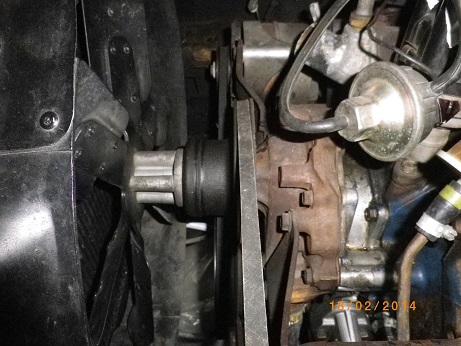
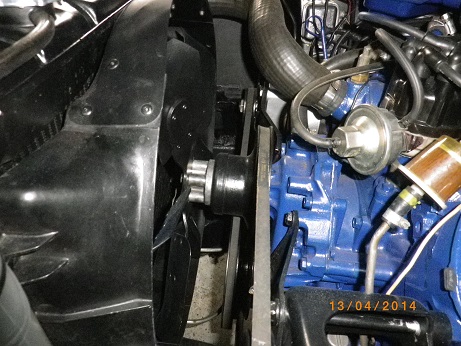
How much better is it?
Well before I could not drive in slow traffic at temperatures around 75-80°F, even with heating turned on at max. Today, I am OK even with heating turned off. The only thing I still can not do today is to sit in heavy jams (not moving) for long periods, at 80°F and up.
I made the change from ported to full manifold vacuum, initial timing was left the same (9-10 degrees BTDC) I adjusted the idle speed and mixture screws for a no load idle sleed of approx 950 rpm.
I took the car out for about an hour, at slow speeds and idling at a stop the temperature would creep up to about 200 (about 10 degrees less than prior) the difference was that once I got moving again the temp would drop back down to about 185-190.
This morning I increased the size of the main jets to 73 (up from 71) and did the same ride, with the jet change it ran about the same temps, the only difference I seen was the car would come back down to the 185-190 range after slow speed/stopped driving a little quicker.
In my opinion the non ported vacuum swap did make a difference and there was a side benefit that the car idles much better now and the low to mid range throttle response feels a lot more responsive.
Attached is a picture of the fan/ shroud /radiator combination .
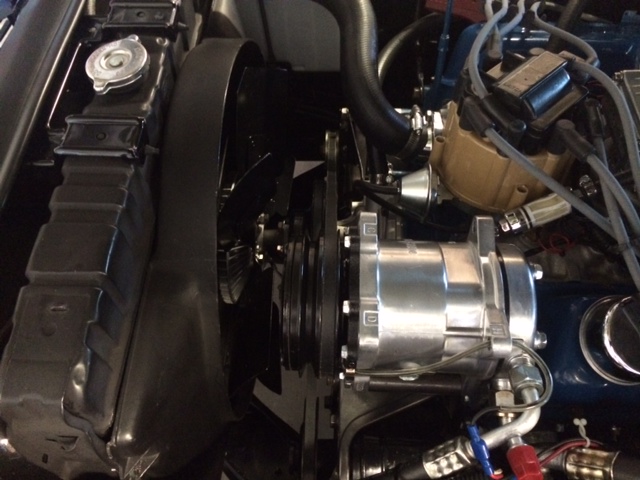
One look at your pic and it’s obvious…there’s the problem.
That MAMMOUTH distributor is blocking about 85% of the airflow.
Took your advice and removed the distributor,damn if it didn’t work, the car sitting there stays at room temperature, seems a lot quieter and will probabaly get a lot better fuel mileage. 
Rolled on the floor laughing at that responses! 
Just be sure to keep an extra solenoid in the glove box. It takes an awful lot of cranking when the engine is adjusted in this mannor. In a way, it’s kinda like those pills they advertise on TV, the side effects are worse than what’s being treated.
Here we go again…

I love it
YES, anyone that uses a GM distributor in a Ford will receive a nudge. Along with anyone using Pertronix distributor. Pertronix drop-in is o-k for replacing points. But, their whole billetized Delco copy doesn’t even come with an adjustable vacuum advance…what the heck? When it comes to ignition curves, one size definitely does not fit all.
Replace that glass gas filter! That thing breaks and you got a big fire on your hands.