Running into a cooling issue now with my 351c.
Car was originally an AC car, but was removed by the last owner.
At first, I thought it might just be a bad fan clutch. I then quickly learned about the flex fan and how AC cars were not equipped with them.
What id like to do is replace the fan and add a fan clutch.
Im tempted to replace the radiator and the water pump just to make sure I dont have any more issues. I live in south Georgia so im sure the heat right now isn’t helping.
Ive read the other forum posts about doing the fan replacement, but before I fully commit to anything, I was hoping to see what the collective recommends.
I knew I forgot something. Yes I’ve got 192 degree thermo in it. I dont remember seeing a restriction plate when I changed the thermostat a few months ago though.
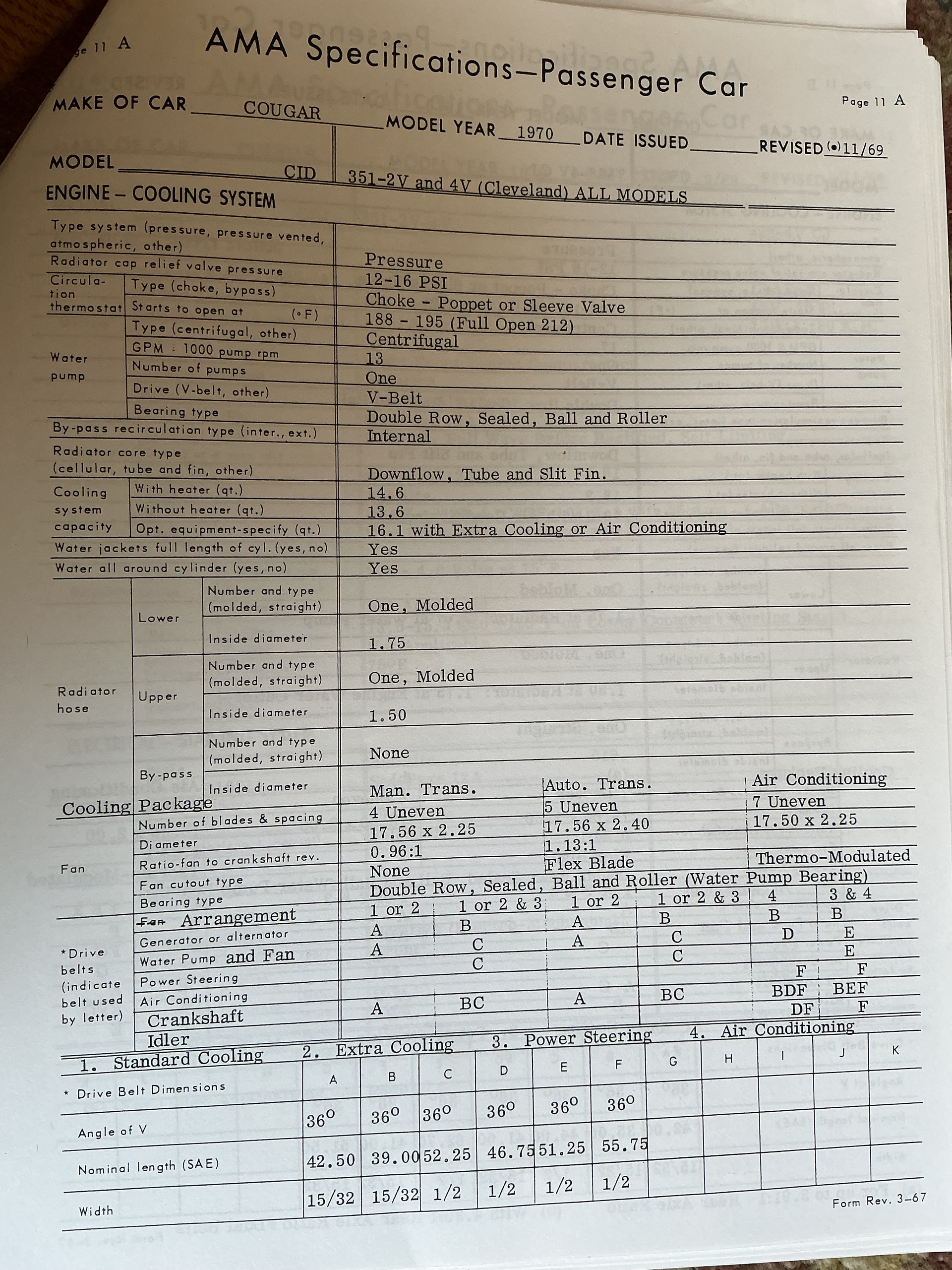
The 70 cars with AC had the 24” 3 row radiators with 7 blade clutch fans. This was also available as the heavy duty cooling option. My 351C had no AC or heavy duty cooling (SF bay car) so it came with the 20” radiator and 5 blade staggered blade flex fan. Not good enough for KC summers, so I upgraded to the heavy duty cooling package.
You definitely need the brass restrictor plate, and the correct Robert Shaw thermostat with the hat. Without both, most of your coolant is just recirculating through the engine rather than being forced through the radiator.
1 Like
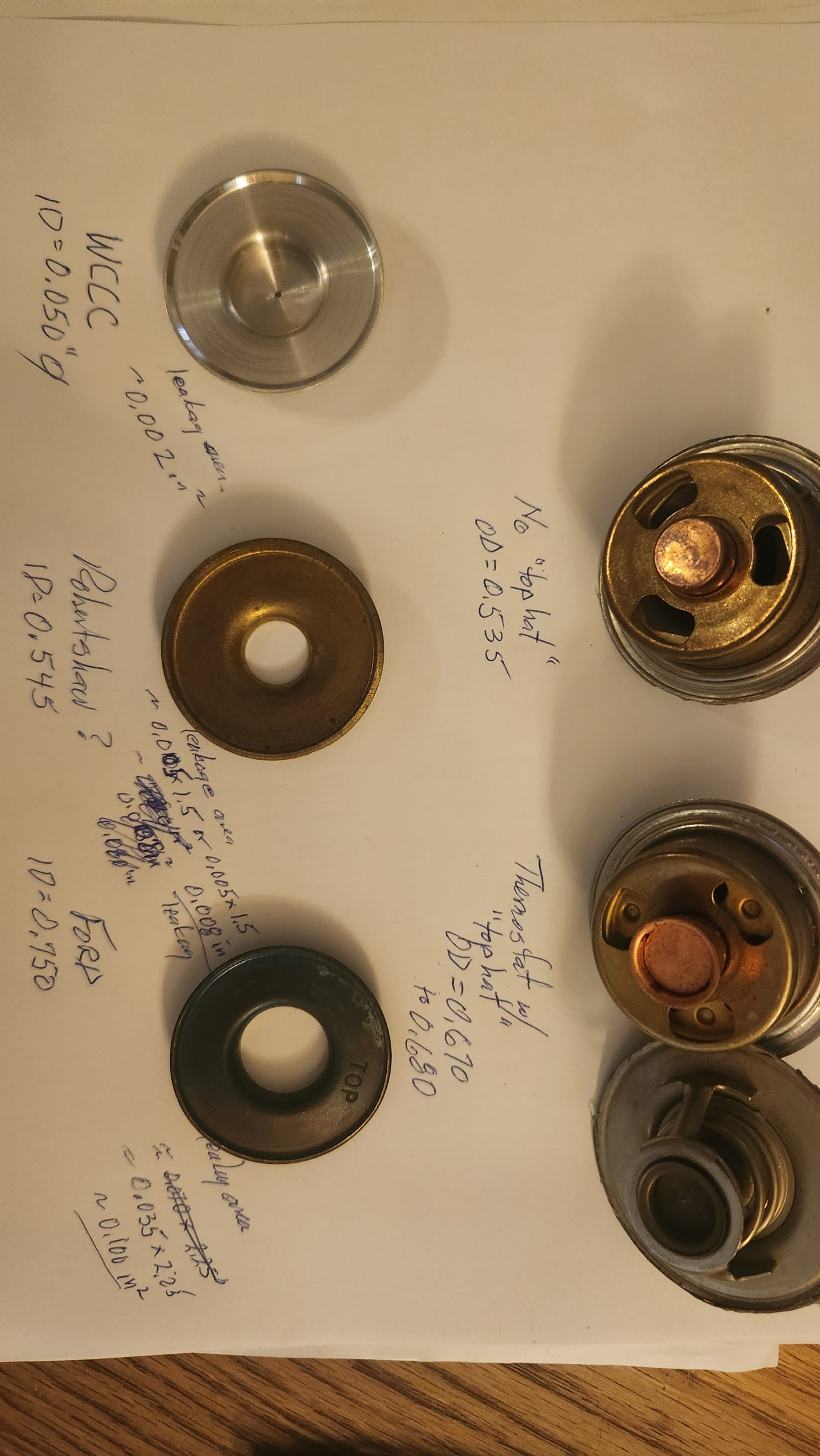
Much of the above is correct but not all. I’ve had two 70 Cougars with 351Cs and factory A/C. Both had 24" three row radiators and they both had 5 blade flex fans (69s had the 7 blade fan but Ford saved a few bucks in 70). That was the factory cooling system upgrade. My current one has a 351C-4V. It had cooling issue at modern Texas highway speeds (80 mph+). I upgraded to the WCCC big block 7 bladed fan with a thermostatic clutch. That definitely helped some in stop and go traffic but as one would expect, not on the highway. I installed a high flow water pump, I don’t think I saw any difference, certainly not on the highway. I removed the factory thermostat bypass orifice with its matching special 351C thermostat and installed the WCCC block (restrictor) plate and the standard thermostat, that gave me a small but noticeable improvement. The factory bypass and special thermostat have a sloppy fit and leak when closed bypassing the radiator with a portion of the flow. The Robertshaw set up above is a bit better. I used it on my engine rebuild but thinking of pulling it and installing the WCCC blocking/restrictor plate that has only a very small bleed hole. The high speed issue was from the engine having been bored 0.060" over. I found references to that issue online but was sceptical until I pulled the engine for a rebuild and found it 0.060 over. The replacement block is 0.030" over and better at speed. Make sure you have a fan shroud and consider the blocking/restrictor plate (it’s aluminum with only a small hole in it). The WCCC big block fan and clutch will help but the restrictor plate is a cheaper first step. Good luck with it.
2 Likes
A further thought. A 24" radiator is all that will fit with some drastic modifications. I’ve seen some discussion on 4 row radiators and as I recall Don Rush (WCCC) indicted they had air flow issues and didn’t help. That’s probably worth checking. I’ve been sceptical of the variety of aluminum radiators and am running a OEM replacement. Copper is a better heat conductor than aluminum but the heat transfer limits are on the air side.
1 Like
The AMA specs show what Ford intended for the 70 model year. They show the larger 24” 3 row radiator for 351 cars with both factory AC and the cooling option. And then the 7 blade thermo fan for all cars with AC. But those specs were sometimes deviated from, and it sounds like some 70 351C’s with AC still got the 5 blade flex fan - interesting! I know my first early 70 351W with AC had the 7 blade thermo fan.
1 Like
Thank you to everyone for the information and general sanity check.
My plan right now is to:
- Remove the old, and cracked, 5 blade flex blade.
- Pull the thermostat and verify the integrity of the restriction plate. (if its even there, i dont remember seeing one)
- Pull the old water pump.
From there:
- Ive got a new 333 thermo and bypass plate coming that I’ll install.
- Put on the new water pump.
- Add a 428 7 blade fan with fan clutch.
I’d like to think that will help solve the issue.
The radiator seems like its in good shape.
Did a flush about 6 months ago and while there was some bloom, it cleaned up well from what I can see.
2 Likes
You are starting from a better place than I was. I had rust and sediment coming out every flush. Ended up having to pull the engine to rod out the block coolant passages. And of course all the things you are doing too. Finally got it running cool enough to drive without fear of overheating and vapor lock.
I struggled with cooling the Cleveland the PO put in my car (non AC, base) with a 20” radiator and 5 blade fan w/o thermostatic clutch. In 2017 I went on an all out assault on the cooling system-24” aluminum DeWitt rad (dual 1” tubes), FlowKooler aluminum water pump, correct Robertshaw t-stat and T Meyer brass restrictor plate, electric cooling fans (dual 11” on deep, full coverage shroud with vent flaps, new hoses with spring in lower hose, new 13 lb cap with recirc design (dual seals), recirculation reservoir, new green pre-mixed coolant, and PWM fan speed controller. No problems with temp since that installation. I had already replaced the alternator (65amp) with a 100 amp.
While the comments are prevalent, I don’t believe the bore OD has anything to do with overheating as the thermodynamics just don’t make sense to me. If the overbore is part of an overall HP increase plan that’s a different story but if the HP is close to the same as before increasing the bore, where does the extra energy come from? I can see a slight change in the rate of heat transfer due to thinner cylinder wall but the combustion heat energy does not change within the cylinder assuming power levels remain close. I’ve heard the argument that there is more frictional heat in the larger bore but the change in surface area is so minimal that I cannot accept Ford designing a cooling system that close to the bleeding edge of capability. The argument of reducing mass of the cylinder increases the energy passed to the cooling system aligns with the comments about slowing down the coolant at various spots to allow for greater heat transfer. That doesn’t make sense either as keeping it in the radiator longer to cool means keeping in the block longer and absorbing more heat. Increasing flow rate-air and water-is always beneficial in increasing the heat transfer of cooling systems.
Checking the factory or Robertshaw orifice plate opening versus the disk on the 351C specific thermostat will give you an idea of the bypass/leakage areas. The WCCC restrictor has a 0.050" diameter vent or about 0.002 sq in leakage/vent path. The Robertshaw(not marked but I think it’s one) has a 0.545 ID and with a 0.535" OD thermostat, it has about a 0.008 sq in leakage path. The Ford orifice has about a 0.750 in ID and the “matching” top hat thermostat with a 0.680" OD or about 0.100 sq in leak path.
Your actual measurements may vary a bit but this should give some perspective on the issue with the factory bypass.
2 Likes
As I said I was a sceptic. A 0.060 oversize cylinder reduces the cylinder wall significantly, Something like 0.150" vs 0.180" (I don’t recall the exact numbers might even be 0.120" vs 0.150"). Thinner wall, more heat transfer to the coolant, until at high speed/high HP (we’re talking 85+ mph) the rest of the cooling system can’t keep up. Clean engine cylinder walls don’t help, higher water flow doesn’t help, bypassing the radiator with thermostat/orifice leakage makes it a bit worse. The bypass change was the only change that gave some noticeable result. New block at 0.030" over is better too.
1 Like
Didn’t realize the restrictor plates differed that much. The RobertShaw one would definitely reduce leakage. My factory restrictor plate hole measures .725” dia. I have avoided the WCCC Pantera version with only a bleed hole because it doesn’t allow coolant circulation through the engine with thermostat closed. I believe Ford did that to keep hot spots from forming during warm up. Maybe it’s not that big of a deal?
The bypass may be more useful in extreme northern climates but in Texas I’ve got a few thousand miles on it with no issues.
i used the newer style restrictor plat and make sure its a cleveland thermostat they are different from a windsor engine .the supply house kept pushing a windsor stat on me they both fit and only the cleveland works write . im in the florida keys has AC and 500 HP haven’t got any cooling issues.
Quick update.
Got the new thermo and restrictor plate. The new thermo shape and plate make sense now.
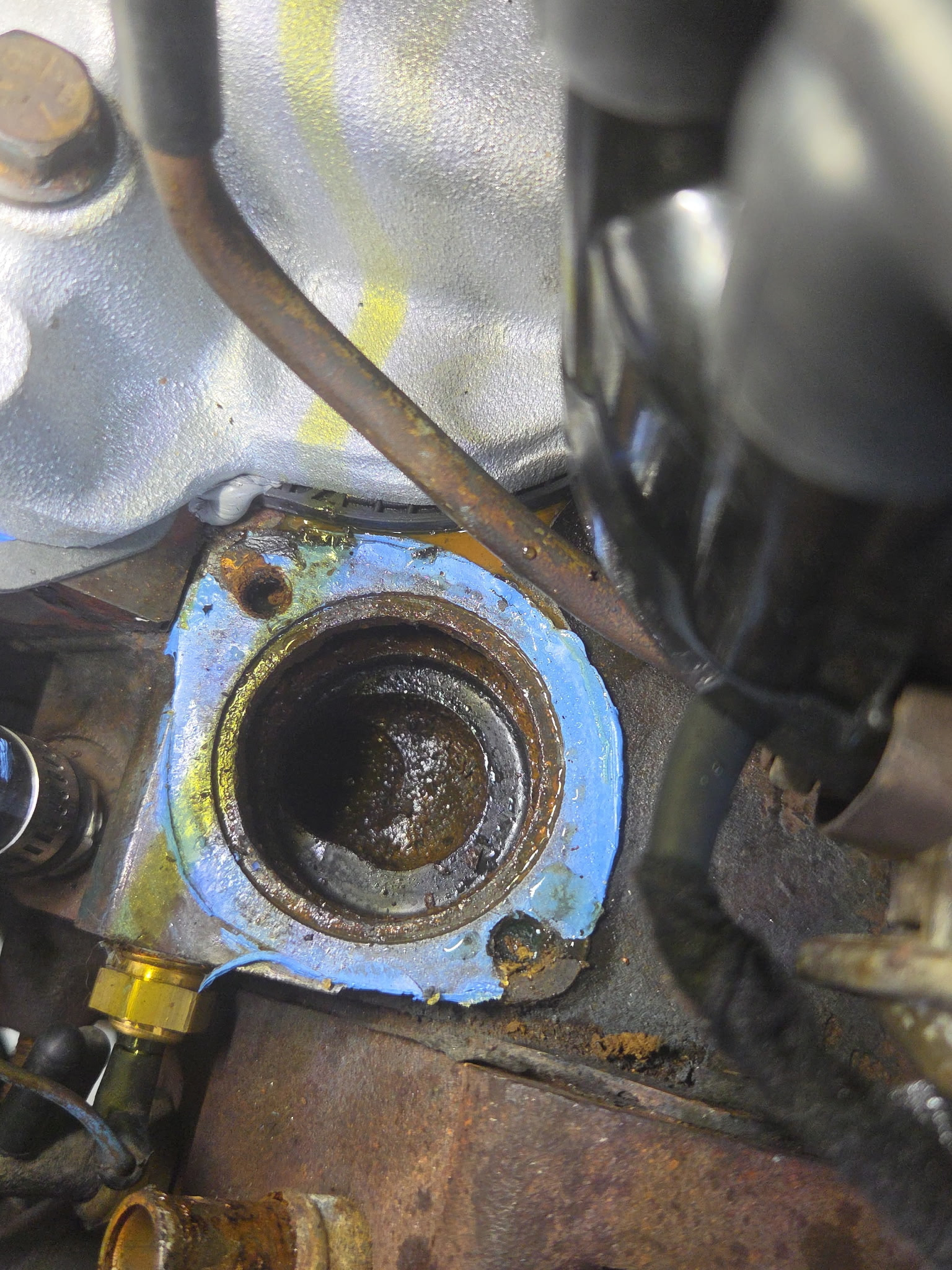
Got the old one out and it looks pretty gross in there. Which doesnt shock me.
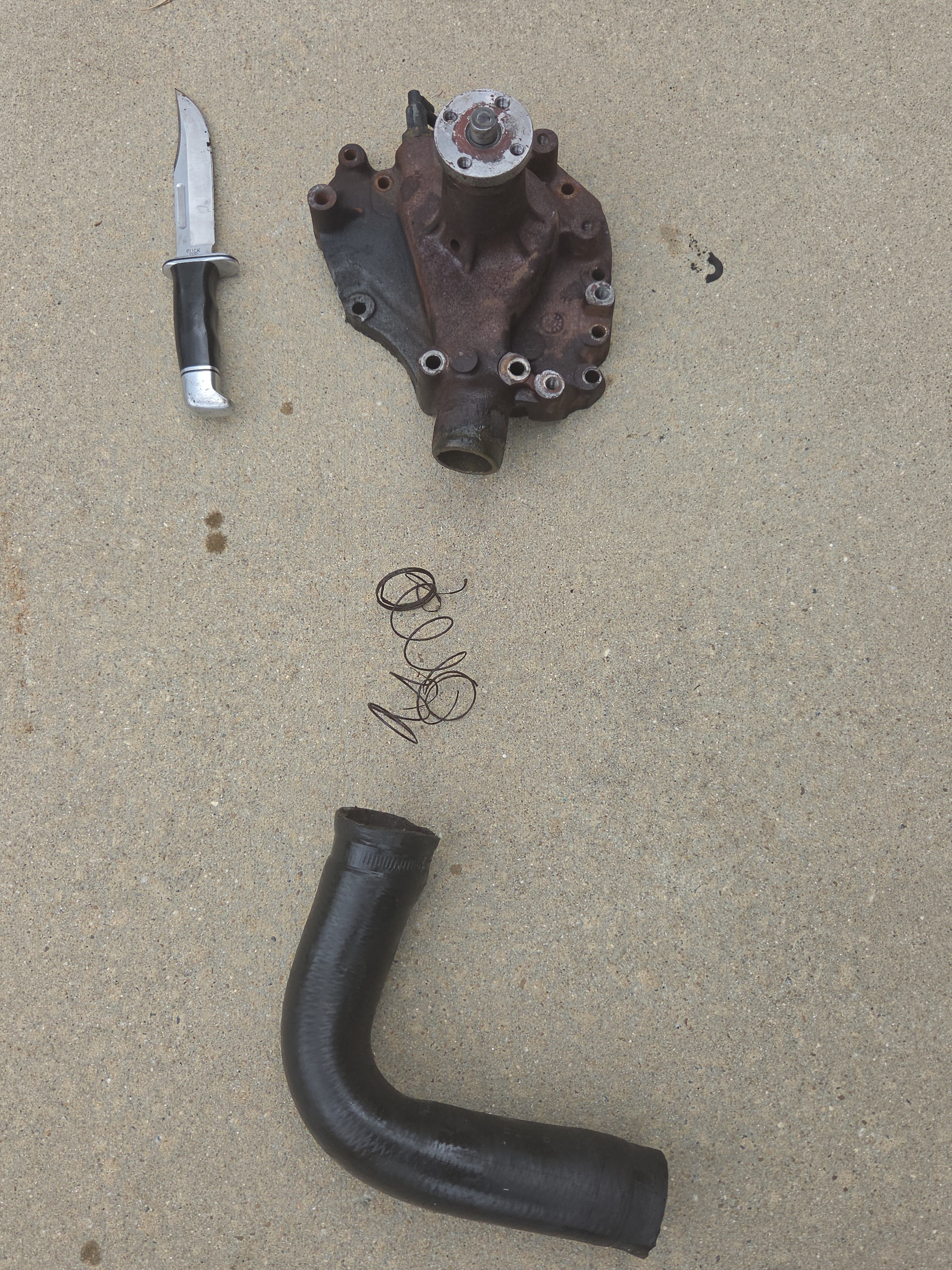
What did shock me was finding an old spring in the return tube to the radiator?
Not sure how or why that would have been in there.
New water pump gets here in a few days. Plan is to flush the block and get all my prep work done prior.
Anyone have any tips for flushing the block coolant passages so they are not so disgusting?
1 Like
The spring would have been in the lower radiator hose (suction side/return to block post pass thru radiator). They are used to keep the hose from collapsing).
The coolant flow is from the bottom of the radiator thru the pump thru the block and heads, thru the thermostat then back to the top of the radiator.
1 Like
Being you are down south, are the hoses to the heater core hooked up? If your heater core is bypassed, the worst thing you can do is loop it together at the engine. This will send hot water right back into the engine. The FE in my 68 Colony Park would run hot. Not all Ford products have a heater control valve, my 69 Cougar does not. The 68 CP does, yet it wasn’t working. It was stuck open. Cruising at 65, if I clamped off the heater hose, the engine would run about 15 degrees cooler since more hot water is directed through the radiator instead of dumped back in the block. If you are bypassing the heater core, make sure flow is blocked between the two heater hose ports. Or, if the heater core is hooked up, yet has no control valve to block flow when the heater isn’t being used, it may be of benefit to add a control valve.
2 Likes
Ive got the new water pump on, and the new fan and fan clutch.
Ive read a few different things about the space from the radiator to the fan clutch. Does anyone have an recommendations? Also do the bolts that retain the fan just screw into the water pump bearing?
If I use the old flex fan spacer that was between the fan and pulley, my new fan is going to he within .75 to and inch from the radiator