67 GT Started Pinging With Load

So, I was driving home yesterday in my 67 GT 390 Cougar from my buddies house and I pull onto one of the county routes, I noticed a noise. So I muted the radio and there was a fairly loud pinging noise every time I dipped into the peddle. I’ve never had any issue dropping the hammer on the car and I have been using middle grade octane gas for years. So here’s what lead me to this point and what I tried. Engine is stock 390 original bore. Was rebuilt at ~80K miles. Still has standard bore and currently 99K miles.

- I got the radiator re-cored this spring but have noticed the car had been running what I felt, hotter than in the past. Never over heating though

- I started noticing that the swing away was not as responsive when I opened the door and it would only work once. It works on vacuum and usually you get about 4-5 actuations before the can runs out of vacuum.

- Last Thursday when I got home I checked out the vacuum line under the column and noticed a crack at one end. I cut it and reinstalled it and tested but it still only did one actuation. So I went hunter the hood and disconnected it and plugged the manifold port.

- Started wondering if this might be why I was running hot since a vacuum leak could cause it.

- Temp gauge on Friday seemed better but it was also hard to tell since the temp in NY had dropped some.

- So then yesterday happens. The drive to my friend’s house was great. Car was running awesome.

- After noticing the pinging sound while driving, I put it into neutral and revved it and there was no pinging. Put it back into drive and rev it and sound was back. So I figured it isn’t coming from one of the accessories on the front of the engine.

- I ruled out the thought of bad gas since I didn’t get any recently and had driven plenty of miles with what was in the tank.

- So I retarded the timing some. No change.

- Filled it full of the highest octane no ethanol gas we have in town. No change.

- Drive today in was rough at times going up a couple of big hills we have. Down shifted to get the revs up which causes the load to lessen and pinging to stop. Cruising at 65 nothing seems wrong unless you hit the throttle hard.

I should also note, cold start fires right up and idles fine. Hoping someone might have some thoughts. Hope it’s something stupid.

Thank you,

Jim

There is “winter “ gas and “summer” gas.

Winter gas evaporates faster. You may have gotten winter gas at the station, not your choice. Summer gas is more expensive to produce.

A hot spot in the combustion chamber is igniting the fuel before the spark plug has a chance. The 2 explosions are crashing into each other making the ping sound you hear. It can eat a hole between cylinders if left to continue. I’ve seen it.

I suspect higher ambient temps and winter gas.

Check a plug to see it’s condition.

Also, summer lead foot syndrome is starting to peak.

Interesting idea about the winter gas. Although I don’t drive in the winter since I’m in NY, I drive the car almost daily until the first salt hits the road and as soon as the roads are clean in the spring. I’ve had the car since 2021, and never had this issue before.

I will have to pull some plugs.

Jim

It could be caused by timing, excess heat or poor octane.

It’s possible your mechanical advance is sticking. Or your vacuum advance is not retracting.

Spark plugs are another possibility. Might try to go one heat range cooler.

Are you coming to Carlisle? I bring my timing light and other tuning tools.

I wish I was going to Carlisle. Just too much going on right now. I have a timing light, vacuum gauge and rpm meter so I will try to work on it. I will also check the distributor plates.

Thanks for the reply,

Jim

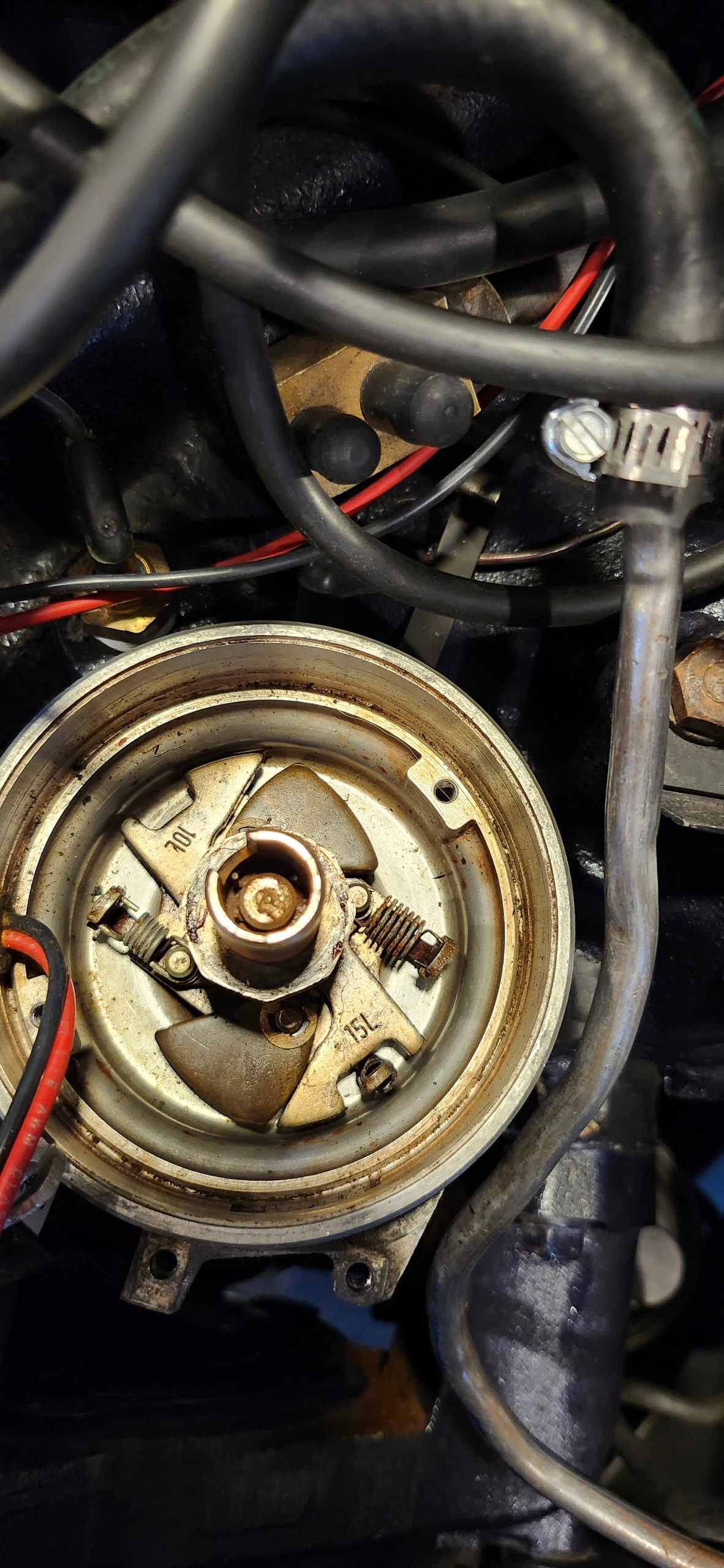
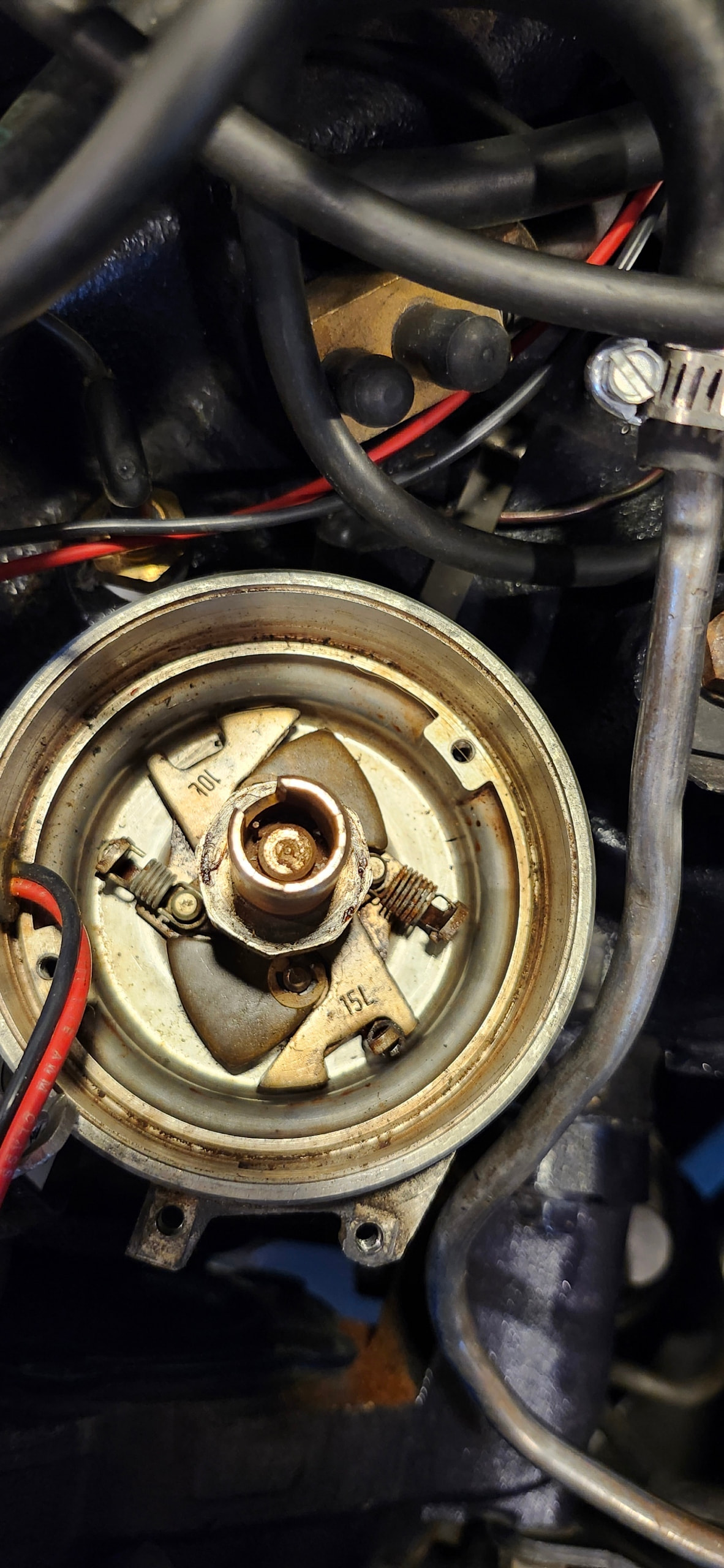
I checked my distributor. Vacuum plate seems to move freely. I didn’t get a chance to hook up my vacuum pump up to it though. I did have time to pull one plug. This is cylinder #5.

The electrode looks pretty decent but there is carbon around the body. This ones got me stumped why suddenly after years of use, it would start doing this.

I do have a brand new 600 CFM carb I was planning on putting on. Maybe that, new plugs and tuning will resolve this?

Jim

My 351C will start pinging a bit under wide open throttle when the gas gets old. Fresh 91 octane ethanol free makes a difference,

I two instances I had a similar issue that turned out to be a very stiff power valve in the carb. The rubber diaphragm had turned very stiff. One more benefit of modern gas.

Well, I took the distributor apart and found that the “Weak” spring was not returning to the advance back to the stop after after pushing it towards advance. So I got a spring kit and cleaned and lubricated the distributor, put a new spring in, timed it to 10 degrees at idle and it still pings like crazy once warmed and under load. I really thought I had found the issue. This just doesn’t make sense to me that it would do this out of the blue. I have a brand new 600 cfm carb on the shelf. Maybe I’ll throw that on.

Position after advancing.

Where it should be after returning.

Carburetor, power valve. I’ve had it happen a couple times over the years. Always a lot more evident on higher compression engines. You should use Holley or Quick Fuel Alcohol/E85 style power valves. These are equipped with Viton or GFLT diaphragms rather than standard rubber. Standard power valve diaphragms can stiffen, crack, or degrade over time when exposed to ethanol. 8.5 or 8.0 is a good standard size. AutoZone shows they carry the quick fuel brand in various sizes. While you have the carb off make sure that it has one of the green accelerator pumps in it, also for the ethanol gas.

1 Like

You’re the second power valve suggestion. I will definitely look into that. Swapping the carb either tonight or tomorrow. Why does a power valve cause pinging though? I would think it would just hurt performance.

Thanks

Goes way too lean when it should be opening and doesn’t.

Detonation vs Pre-ignition: These two terms are often used interchangeably, but they are completely different phenomena: Pre-ignition is caused by hot spots (carbon, spark plug) igniting the mixture before the spark plug fires, BTDC. Detonation (pinging) is post ignition, caused by the pressure of the flame front igniting pockets of fuel in the combustion chamber, ATDC.

Engine pinging, also known as engine knocking or detonation is caused when the compressed fuel air mixture hits the conditions where it can spontaneously ignite. When this happens at the same time or after the spark, and creates a second, imbalanced pressure wave. This can change when the load on the engine changes.

You can think of it as when cruising down the road at a constant speed the engine is working an ideal speed for economy and ideal spark timing. Then you pass someone or go up an incline and require more power from the engine. This requires more fuel for more power. This is where the power valve comes in. The throttle opens more, the engine vacuum drops some and this causes the power valve to open and add for fuel to the mixture. This in turn changes the burn rate a little and it burns more smoothly when under load until it returns to the normal cruise load and the power valve closes and goes back to the economy setting. The different numbers on the power valve determine at what engine vacuum they open. 8.5 – 8 inHg are most common.

Pre-ignition is when this happens before the spark creating a pressure wave that opposes piston movement.

The octane rating of a fuel is a measure of its ability to withstand compression without auto-igniting. Essentially, it can take a lot of compression and will only ignite when it’s told to ignite. Engines with higher compression ratios tend to require higher octane fuel to prevent pre-ignition and detonation.

YouTube video on this: https://www.youtube.com/watch?v=OuXyOyOWLN8

1 Like

Thanks everyone for your replies.

Over the weekend I was able to swap the carb out with a brand new 600 CFM Quick Fuel Slayer. Same results. So I guess it’s not the power valve. Vacuum gauge reads just under 15 at 10-12 degrees at idle. The idle screws seem to have no effect on vacuum unless you turn them all in which obviously kills the engine.

So I got to thinking about vacuum leaks in the brake booster or the A/T vacuum modulator. So I capped them both off as well as the advance. Basically setting up the engine with no vacuum accessories. Vacuum gauge read the same and acted the same with idle bleeds.

The only thing that makes the vacuum increase is when I advance the timing (it will jump into 17-20), which in turn makes the pinging/knocking worse. 10-12 degrees makes the idle a little rough.

I don’t know what else to do. I have to get it inspected tomorrow so I’m thinking of throwing in the towel and having them look at.

Jim

I know this doesn’t help. But why do have to get a car THAT old inspected??? I mean they inspect in Ohio, but all they do is look at the vin, Bob’s your uncle… You’re in your way.

I am still suspicious you got some bad gas, or had very old gas in your tank. Could try flushing out the tank? Also, there is no vacuum advance unit on your distributor in the pics. What is going on there? You mention the timing jumps into the higher range - it should advance or retard very smoothly as you rotate the distributor. In my experience, you can always back off the base timing to a place where pinging will stop.

The gas is not old since I’ve been driving the car regularly since mid march. As for bad gas, this all started about half way through the gas I had bought. The car was running perfect on the last fill. Just in case, I also put in the highest octane around with no ethanol. So I’ve ruled out gas issues.

As for the vacuum advance, I took it out to get at the inner parts of the distributor. I guess jump was a bad word to use. It smoothly increases as I add advance.

Thanks, Jim

NY always makes you do a yearly inspection to make sure brakes, lights, wipers etc. work.

Yeah, that rules out gas. I’ve never had timing in the normal range (10-12 deg) make it idle rough - wonder if that could be a clue? Have you checked the centrifugal advance curve (timing vs engine RPM) with vacuum advance disconnected? Maybe you have the wrong spring and timing is advancing too far as RPM increases?

It shows that the 600 Slayer comes with a 6.5 power valve. You might try a 8.5 and see if that helps. it will open sooner. As for the idle screws, make sure the throttle plates are closing. The new carb might be set too high which would give it a higher idle. Also try a lower timing advance and see it that gets rid of the ping. What are you showing for total advance around 3,000 rpm? Should be around 34-36 degrees with vacuum advance disconnected.